
Maester component
Table of Contents
General information
Description
This component provides direct communication with Maester, the object storage service on the elastic.io platform. It allows you to store, retrieve, search, and delete objects within your integration flows.
Environment variables
There are no required environment variables for this component.
Triggers
This component has no trigger functions. This means it will not be accessible to select as a first component during the integration flow design.
Actions
Within the Actions section of the documentation, you can leverage the Maester component, along with its Upsert Object action, to seamlessly integrate your data. Simply provide the body of your Webhook in the Data field. The Upsert Criteria will dynamically generate the Maester Object ID, which you can retrieve as an output.
In another flow, incorporating the Maester component and its Lookup Object (at Most One) action, you can effortlessly retrieve the desired data. Choose the Maester Object ID as the Lookup Criteria and supply the ID obtained from the previous flow.
For further streamlining the connection of Maester Object IDs across your workflows, consider utilizing the ID Linking component.
Delete Object
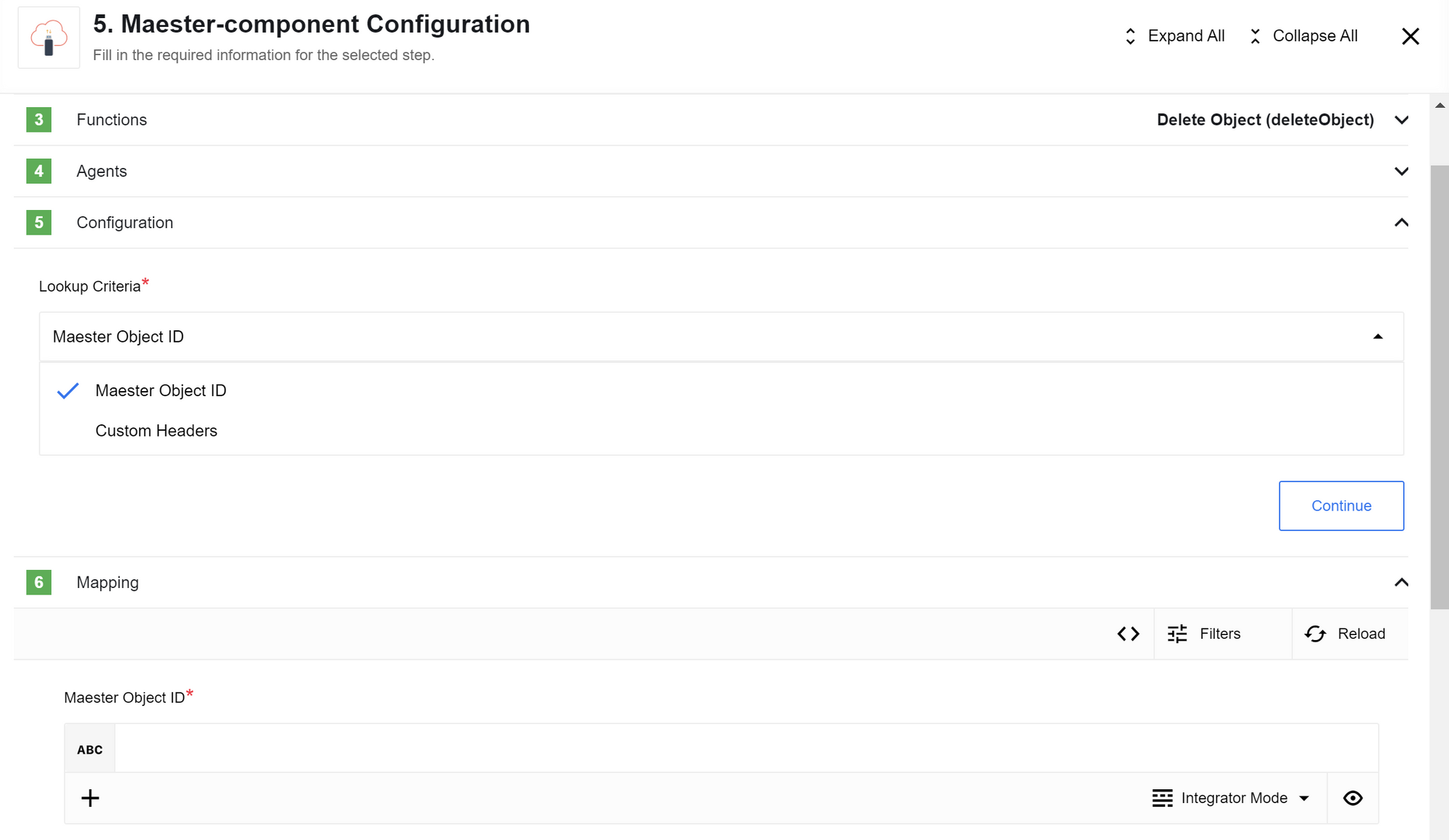
Deletes a specific object from Maester based on the provided criteria.
Config Fields
- Lookup Criteria - (Dropdown with options: [
Maester Object ID,Custom Headers], required): Specifies the method used to identify the object to delete.
Input Metadata
Dynamically generated based on Lookup Criteria:
Maester Object ID(string, uuid) - Required ifLookup CriteriaisMaester Object ID. The unique UUID of the object in Maester.Search Headers- Required ifLookup CriteriaisCustom Headers. An array of headers{ key: header-key-1, value: header-value-1 }used to find the object (up to 5 headers).Data(JSON object) - Required. The data to be stored in the object. Only plain objects are supported.Headers- Optional. An array of headers{ key: header-key-1, value: header-value-1 }to be added to new objects.TTL(number) - Optional. Time-To-Live in seconds. The object will remain in the database for this duration. After expiration, it will be deleted.Please Note: The deletion process runs hourly. If omitted, the default expiration time of the Maester installation is used.
Output Metadata
Click to expand Delete Action Metadata for more details:
{
  "type": "object",
  "properties": {
    "id": {
      "type": "string"
    }
  }
}
Lookup Object (at Most One)
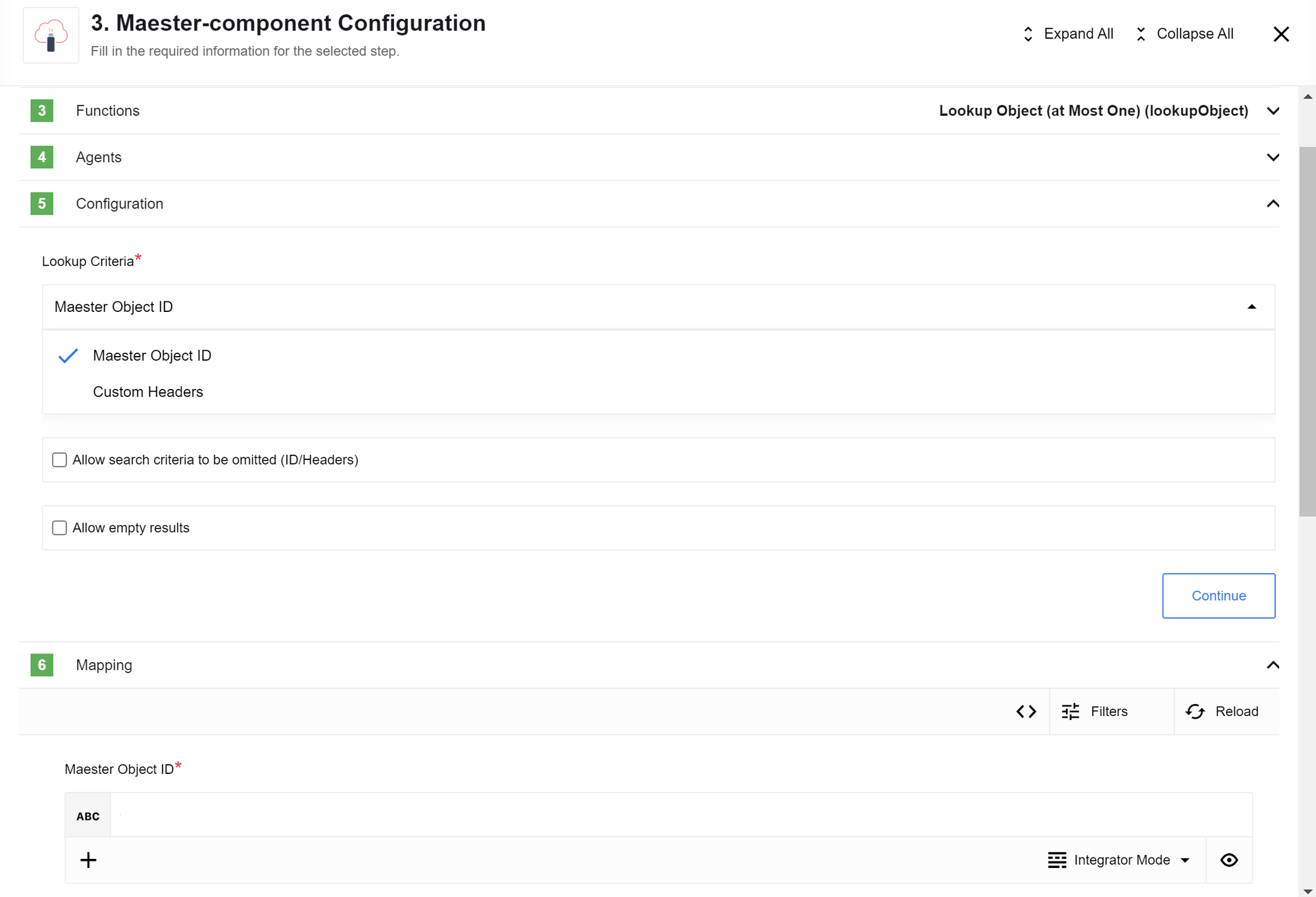
Finds a single object in Maester.
Please Note: If
Lookup CriteriaisCustom Headersand more than one object is found, an error will be thrown.
Config Fields
- Lookup Criteria - (Dropdown with options: [
Maester Object ID,Custom Headers], required): Specifies the method used to find the object. - Allow search criteria to be omitted (ID/Headers) - Checkbox (optional, default
false):- If selected and no search criteria are provided (e.g., missing ID or empty headers), an empty object
{}is emitted. - If not selected, an error is typically thrown when criteria are missing.
- If selected and no search criteria are provided (e.g., missing ID or empty headers), an empty object
- Allow empty results - Checkbox (optional, default
false):- If selected and no object is found, an empty object
{}is emitted. - If not selected, an error is thrown when no object is found.
- If selected and no object is found, an empty object
Input Metadata
Dynamically generated based on Lookup Criteria:
Maester Object ID(string, uuid) - Required ifLookup CriteriaisMaester Object ID. The unique UUID of the object in Maester.Search Headers- Required ifLookup CriteriaisCustom Headers. An array of headers{ key: header-key-1, value: header-value-1 }used to find the object (up to 5 headers).
Output Metadata
Click to expand Lookup Action Metadata for more details:
{
  "type": "object",
  "properties": {
    "data": {
      "type": "object",
      "required": true
    },
    "maesterObjectId": {
      "type": "string",
      "required": true
    },
    "metaHeaders": {
      "type": "array",
      "items": {
        "type": "object",
        "properties": {
          "key": {
            "type": "object",
            "required": true
          },
          "value": {
            "type": "object",
            "required": true
          }
        }
      }
    },
    "searchHeaders": {
      "type": "array",
      "items": {
        "type": "object",
        "properties": {
          "key": {
            "type": "object",
            "required": true
          },
          "value": {
            "type": "object",
            "required": true
          }
        }
      }
    }
  }
}
Lookup Objects
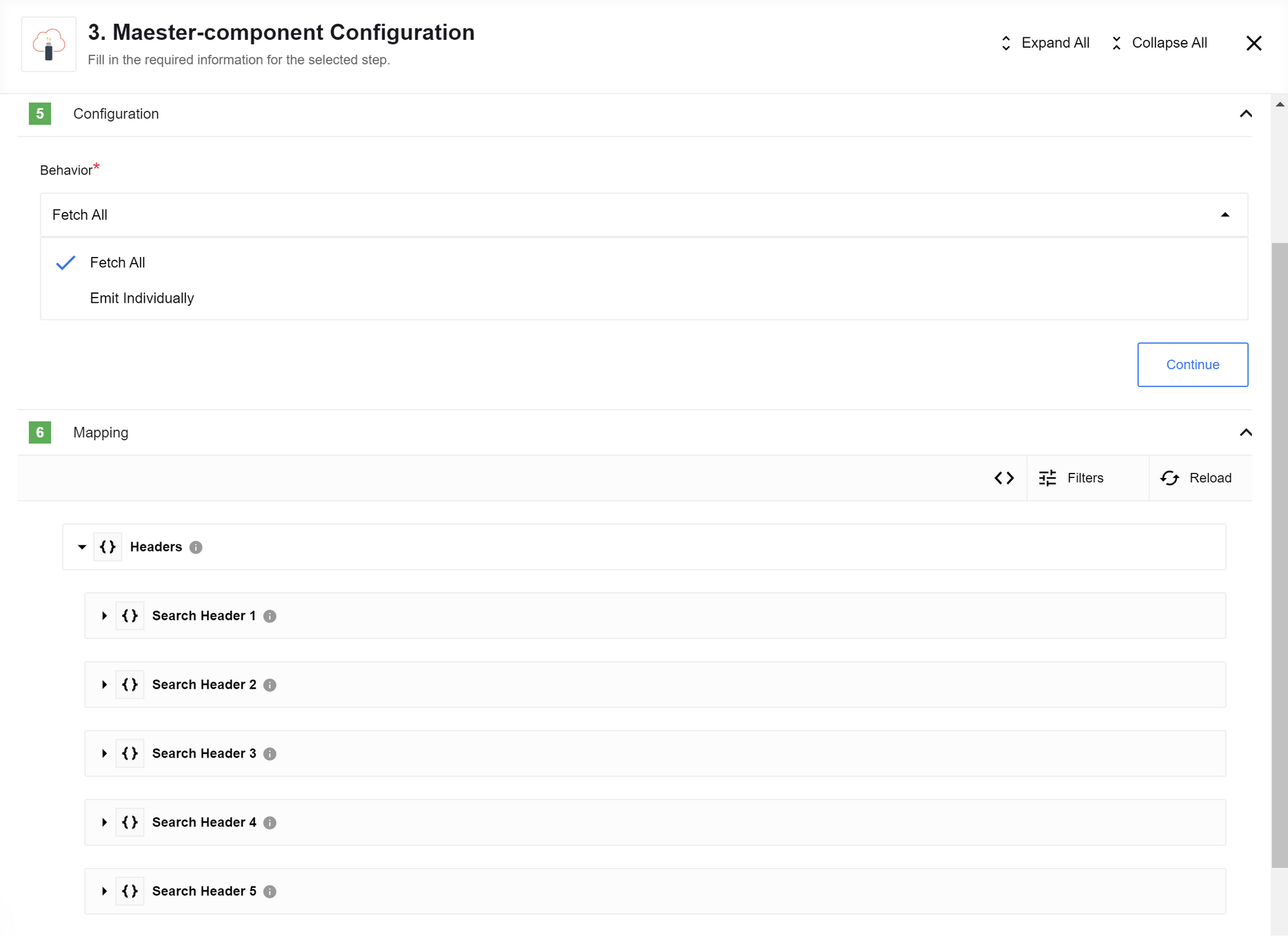
Searches for multiple objects in Maester based on custom headers.
Config Fields
- Behavior - Configures the output format:
Fetch All- The output will be a single message containing an array of all found objects.Emit Individually- Each found object will be emitted as a separate message.
Input Metadata
Headers- Required. An array of headers{ key: header-key-1, value: header-value-1 }used to search for objects.
Upsert Object
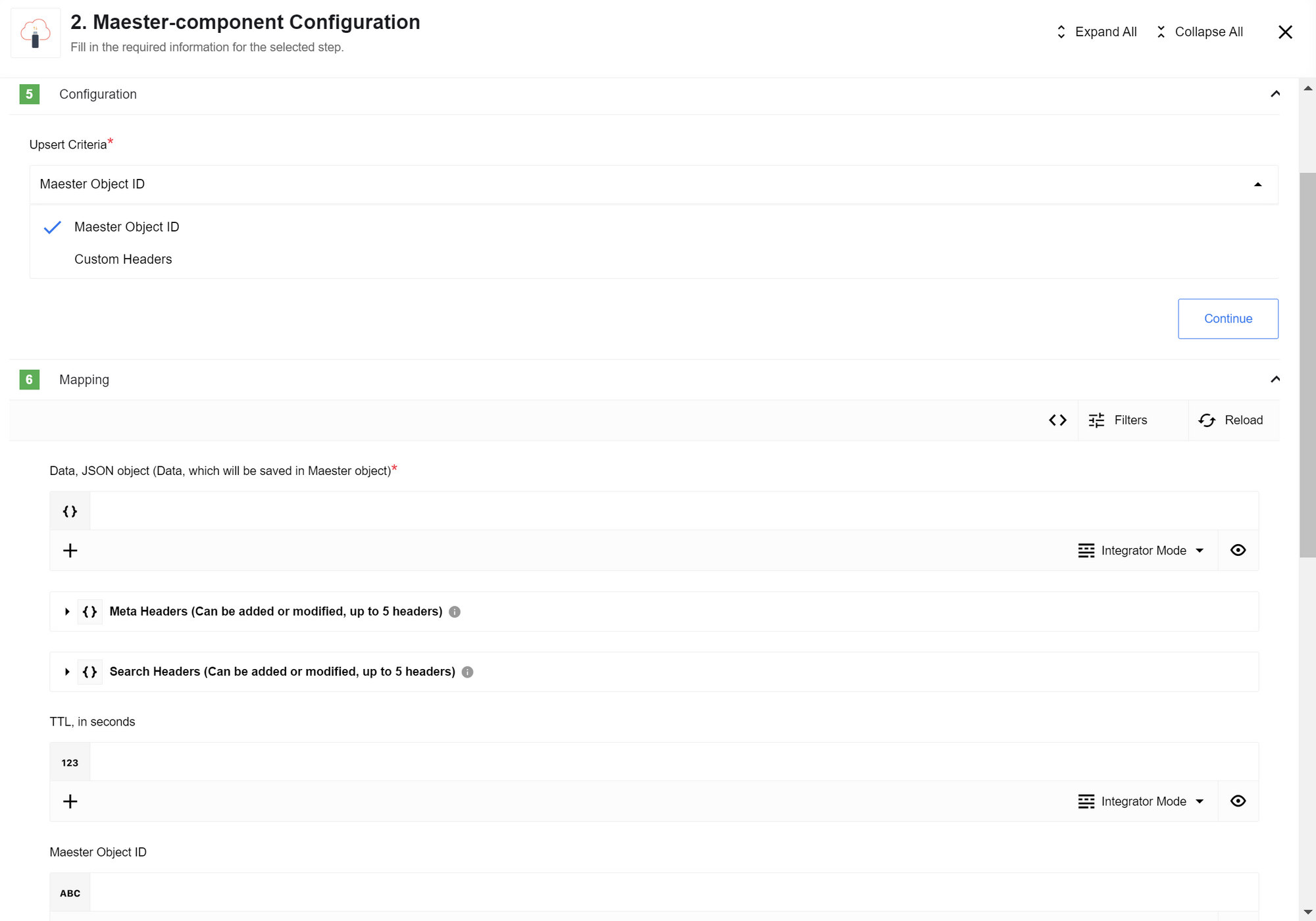
Creates a new object or updates an existing one based on the criteria.
Logic:
- Upsert Criteria: Maester Object ID
- Attempts to find an object with the given ID.
- If found: Updates the object.
- If not found: Creates a new object.
Please Note: When a new object is created this way, it will be assigned a NEW ID generated by Maester. The provided ID is not used for the new object.
- Upsert Criteria: Custom Headers
- Attempts to find an object matching the given search headers (up to 5).
- If found: Updates the object.
- If not found: Creates a new object.
Please Note: If more than one object is found matching the headers, an error will be thrown.
Config Fields
- Upsert Criteria - (Dropdown with options: [
Maester Object ID,Custom Headers], required): Specifies the method used to identify the object to upsert.
Input Metadata
Dynamically generated based on Upsert Criteria:
Maester Object ID(string, uuid) - Optional. Used ifUpsert CriteriaisMaester Object ID. The ID to find the object.Search Headers- Required ifUpsert CriteriaisCustom Headers. An array of headers{ key: header-key-1, value: header-value-1 }used to find the object (up to 5 headers).Data(JSON object) - Required. The data to be stored in the object.Headers- Optional. An array of headers{ key: header-key-1, value: header-value-1 }to be added to the object.Please Note: Headers can be added to an existing object or modified, but they cannot be deleted.
TTL(number) - Optional. Time-To-Live in seconds.Please Note: The deletion process runs hourly. If omitted, the default expiration time is used. TTL cannot be modified or removed once the object is created.
Output Metadata
Click to expand Upsert Action Metadata for more details:
{
  "type": "object",
  "properties": {
    "data": {
      "type": "object",
      "required": true
    },
    "maesterObjectId": {
      "type": "string",
      "required": true
    },
    "metaHeaders": {
      "type": "array",
      "items": {
        "type": "object",
        "properties": {
          "key": {
            "type": "object",
            "required": true
          },
          "value": {
            "type": "object",
            "required": true
          }
        }
      }
    },
    "searchHeaders": {
      "type": "array",
      "items": {
        "type": "object",
        "properties": {
          "key": {
            "type": "object",
            "required": true
          },
          "value": {
            "type": "object",
            "required": true
          }
        }
      }
    }
  }
}
Known issues
- Object TTL is not included in the output metadata.
- TTL value will be ignored when updating an existing object.
Click here to learn more about the elastic.io iPaaS