Content-Based Routing Overview
Most flows you build early on are linear: a trigger fires, and a fixed sequence of actions runs on every message the same way. That works fine until you hit a case where different messages need different handling — some orders ship domestically and some internationally, some leads are enterprise and some are self-serve, some product updates belong on one storefront and some on another. Content-Based Routing is the platform feature that lets one flow make that decision per-message, instead of you maintaining several near-identical flows by hand.
The idea
A Content-Based Router sits in your flow like any other action, but instead of doing one thing to every message, it evaluates each message against a set of conditions you define — one per branch — and forwards the message down the first branch whose condition matches. Everything downstream of that branch only ever sees messages that satisfy it.
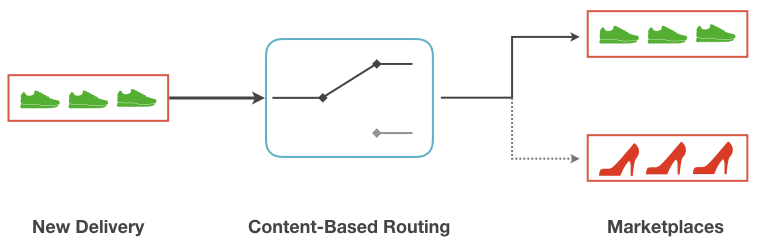
In the diagram above, a single incoming stream of orders is split by product type: sport shoes go to one downstream system, other shoe types to another. Nothing about the trigger or the incoming data changes — only what happens after the router does.
How the conditions work
Each branch’s condition is a JSONata expression evaluated against the message — the same expression language used elsewhere on the platform for transforming data. The expression must resolve to true or false; the first branch that evaluates to true receives the message. A router configured with a single branch behaves as a simple filter — pass or drop — rather than a full multi-way split.
Because the condition is just an expression over the message’s own fields, you’re not limited to equality checks on one field — you can combine multiple conditions, compare numbers, or check whether a field exists at all.
When to reach for it
Content-Based Routing is worth using whenever you catch yourself about to build two or more flows that are identical except for a filter at the top, or a manual step where someone decides which system a record should go to. Common cases:
- Splitting orders, leads, or tickets by region, tier, or type across different destination systems
- Sending only records that meet a threshold (an order total, a priority level) further down a flow, and quietly dropping the rest
- Feeding the same trigger into several unrelated downstream actions without duplicating the trigger itself
Related links
- Content-Based Routing — the full walkthrough, including building a working example step by step
- Router component
- Transforming data
- Creating a Basic Integration Flow